Skip to content
Ownlisted
ResearchData & PressDirectory
OwnlistedResearchThe 2026 US Medical Weight Loss Market: 3,039 Clinics Mapped Across America

Contents

  1. Market Overview: The GLP-1 Era
  2. The Access Gap: Where Obesity Is Worst, Clinics Are Fewest
  3. GLP-1 Adoption: 58% of Clinics List These Medications
  4. Ratings & Reviews: A Near-Universal 5-Star Floor
  5. Frequently Asked Questions
  6. Methodology
  7. Cite this study
Download dataset (CSV)

3,039 records

Medical Weight Loss Clinics

The 2026 US Medical Weight Loss Market: 3,039 Clinics Mapped Across America

An original data study mapping 3,039 active medical weight loss clinics across 44 US states — with a full 50-state access gap analysis, GLP-1 adoption data, and the geographic mismatch between where obesity is highest and where clinics actually exist.

By Ownlisted Research·Published April 24, 2026·3,039 records·9 charts

Contents

  1. Market Overview: The GLP-1 Era
  2. The Access Gap: Where Obesity Is Worst, Clinics Are Fewest
  3. GLP-1 Adoption: 58% of Clinics List These Medications
  4. Ratings & Reviews: A Near-Universal 5-Star Floor
  5. Frequently Asked Questions
  6. Methodology
  7. Cite this study

Executive Summary

  • 3,039 active medical weight loss clinics are listed across 44 US states and Washington D.C. as of April 2026 — a market reshaped by the GLP-1 pharmaceutical era.
  • Eight US states have zero listed clinics, including West Virginia (highest adult obesity rate in the nation at 41.4%), Maine, and New Hampshire.
  • 58% of clinics in the directory explicitly list GLP-1 medications — semaglutide or tirzepatide — as offered services.
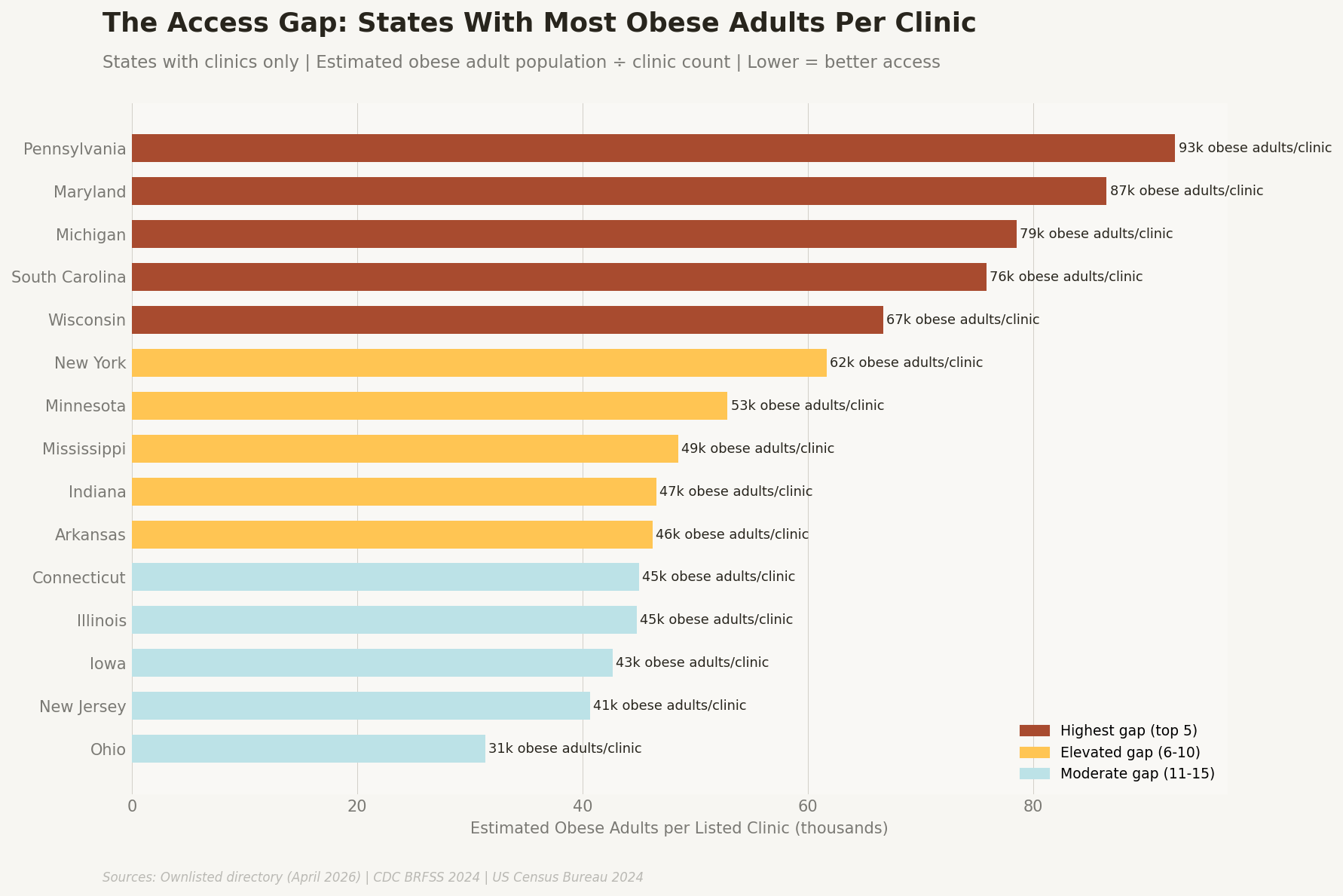
  • The access gap is severe: Pennsylvania has an estimated 93,000 obese adults per listed clinic; Maryland, 87,000; Michigan, 79,000.
  • No meaningful correlation exists between state obesity rates and clinic density (r = −0.12, p = 0.46) — the market has not built where obesity is worst.
Download the full dataset (CSV, 3,039 records)

Key findings

3,039
Active medical weight loss clinics
Across 44 US states and Washington D.C. as of April 2026.
8
States with zero listed clinics
Including West Virginia — the most obese state in the nation at 41.4% adult obesity prevalence.
58%
Of clinics list GLP-1 medications
Semaglutide or tirzepatide explicitly listed as offered services — documenting the GLP-1 era's penetration.
93,000
Obese adults per clinic — Pennsylvania
The worst access gap of any state with active clinic listings.
4.80 / 5
Mean Google rating
Across 2,937 rated clinics. 87% hold a rounded 5-star average.
46
Median Google reviews per clinic
Consistent with a rapidly scaling market where new entrants sit alongside established practices.

Market Overview: The GLP-1 Era

The US medical weight loss market did not build gradually to its current scale. It accelerated.

The FDA approved semaglutide (Wegovy) for chronic weight management in June 2021. Tirzepatide (Zepbound) received its weight-management approval in November 2023. The market response was immediate: approximately 5 million Americans were on GLP-1 therapy in 2023; by 2025, roughly 10 million. J.P. Morgan projects 25 million Americans on GLP-1 treatment by 2030.

Grand View Research values the GLP-1 agonists weight loss drugs market at $13.84 billion in 2024, projecting growth to $48.84 billion by 2030 at an 18.5% CAGR. The broader US medical weight loss market more than doubled in value between 2022 and 2024 (Research and Markets, March 2025).

The 3,039 clinics in the Ownlisted directory represent a snapshot of supply at an inflection point.
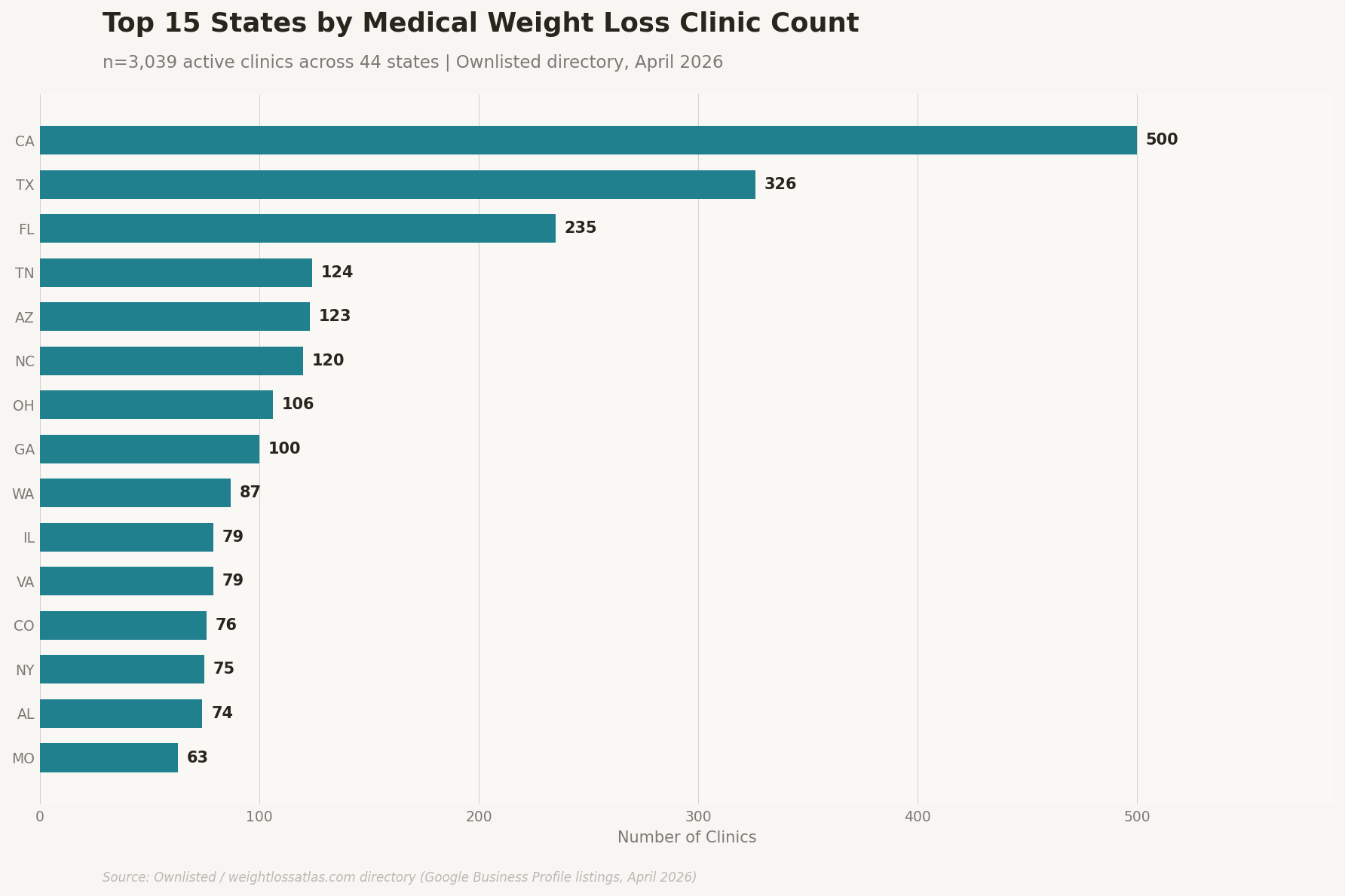
Horizontal bar chart showing the top 15 US states by medical weight loss clinic count, led by California (500), Texas (326), and Florida (235).
Top 15 States by Medical Weight Loss Clinic CountCalifornia (500), Texas (326), and Florida (235) lead by raw clinic count, reflecting their large populations. Source: Ownlisted directory data, April 2026.
JSON dataCSV data
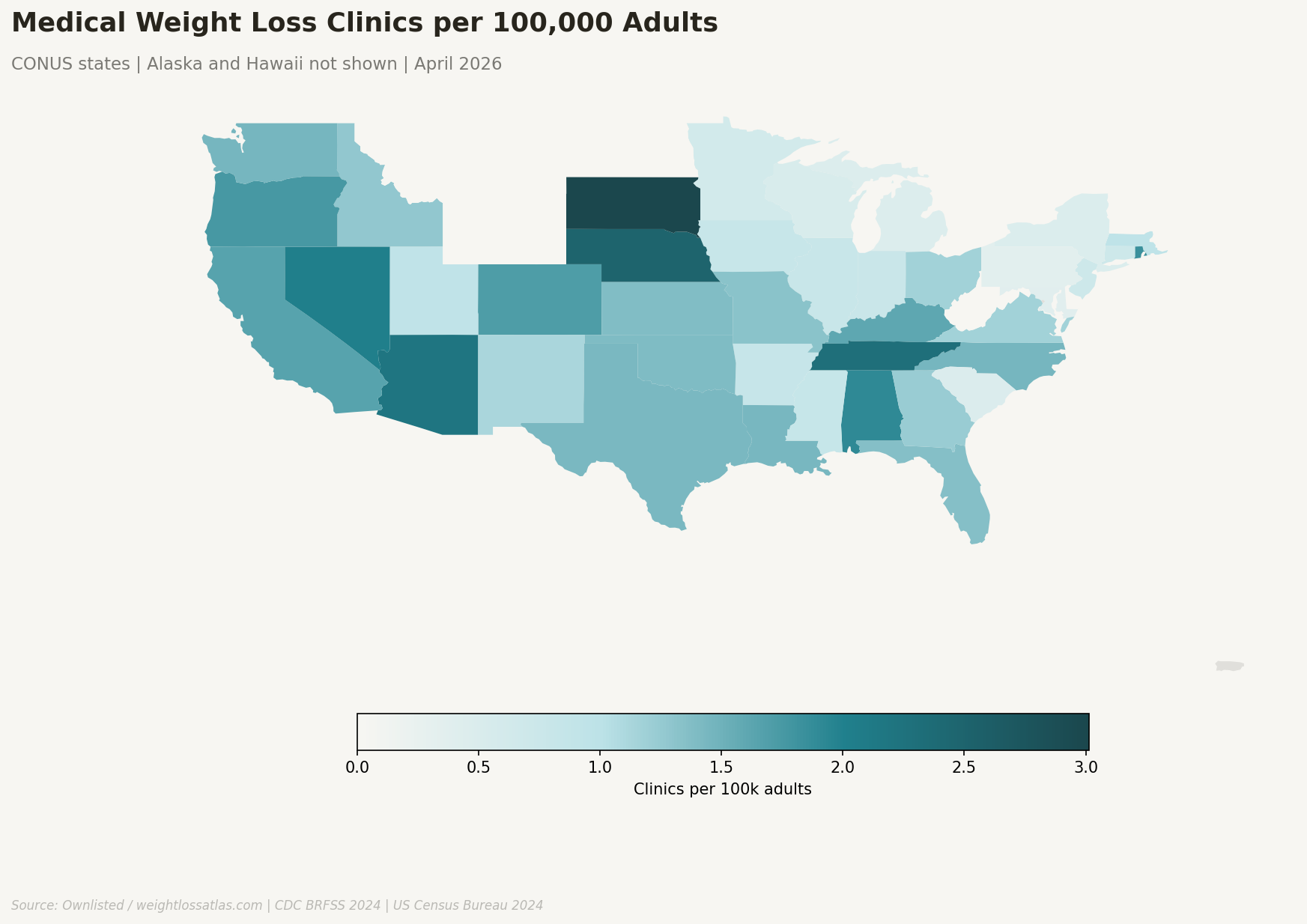
US choropleth map showing medical weight loss clinics per 100,000 adults by state, with Washington D.C., South Dakota, and Tennessee showing the highest per-capita density.
Medical Weight Loss Clinics per 100,000 AdultsWashington D.C. (3.14/100k), South Dakota (3.01/100k), and Tennessee (2.30/100k) have the highest clinic density on a per-capita basis. Source: Ownlisted directory + 2024 Census estimates.
JSON dataCSV data

The Access Gap: Where Obesity Is Worst, Clinics Are Fewest

The headline finding is not simply the scale of the market. It's the mismatch at the center of it.

Eight US states have zero listed medical weight loss clinics: West Virginia, Maine, New Hampshire, Delaware, Montana, North Dakota, Vermont, and Wyoming.

West Virginia — the most obese state in the country, at 41.4% adult obesity prevalence — has no listed clinics. Pennsylvania has 37 listed clinics for more than 10 million adults: an estimated 93,000 obese adults for every single listing.

The access gap metric (estimated obese adults per listed clinic) reveals which states are most underserved relative to their disease burden:

Rank State Obesity Rate Clinics Gap (obese adults/clinic)
1 Pennsylvania 33.9% 37 ~93,000
2 Maryland 33.0% 18 ~87,000
3 Michigan 36.6% 37 ~79,000

The geographic pattern reflects structural factors: medical weight loss clinics have concentrated in states with higher disposable incomes, stronger private insurance coverage, and urban commercial corridors that support outpatient specialty practices.
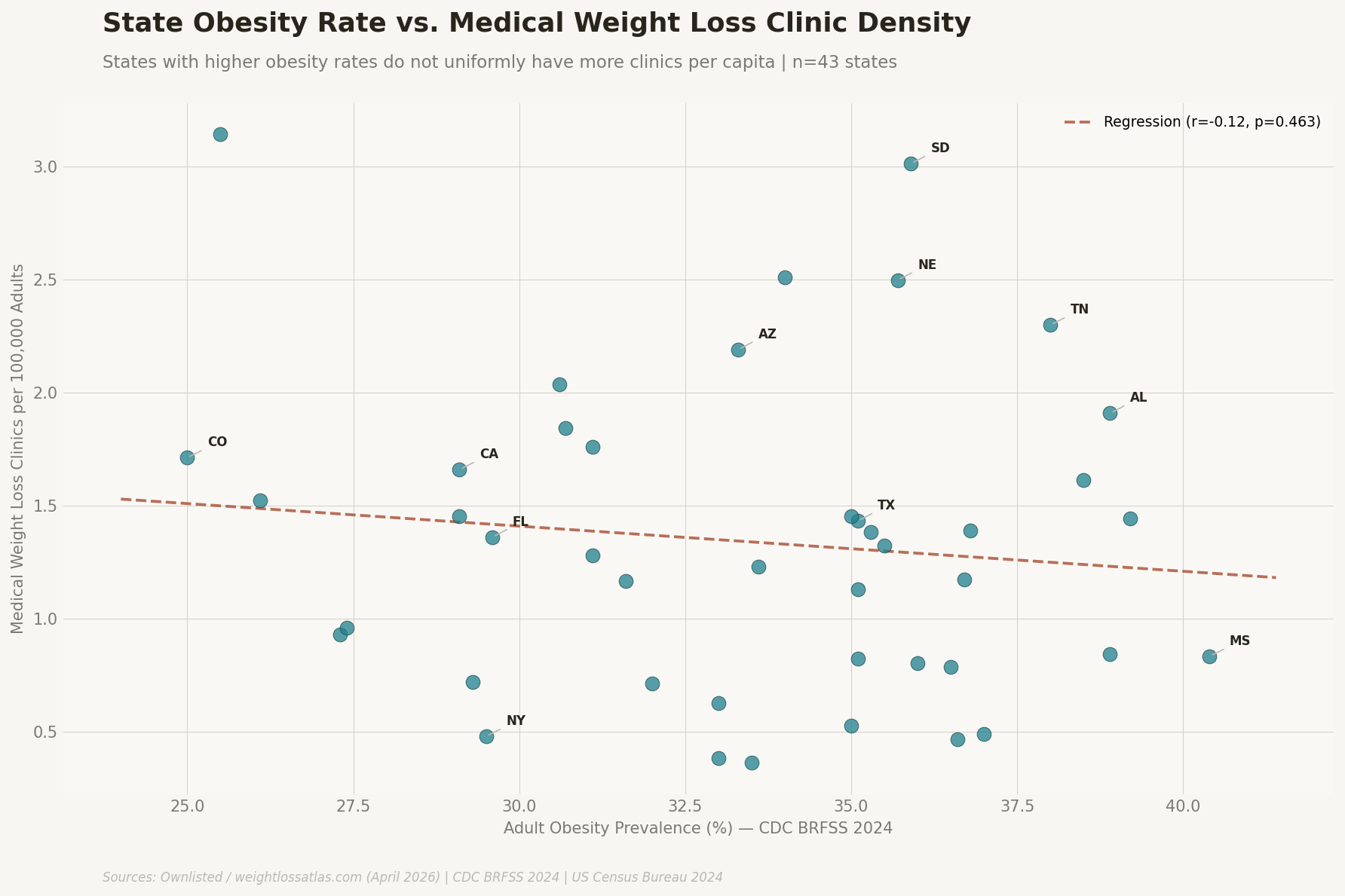
Scatter plot comparing state adult obesity prevalence to medical weight loss clinic density per 100,000 adults, showing near-zero correlation (r = −0.12) — high-obesity states like West Virginia and Pennsylvania have far fewer clinics than low-obesity states like California and Arizona.
Obesity Prevalence vs. Clinic Density by StateNo meaningful correlation exists between state obesity rates and clinic density (r = −0.12, p = 0.46). Source: Ownlisted directory + CDC BRFSS 2024.
JSON dataCSV data
Horizontal bar chart showing the 15 states with the worst medical weight loss clinic access gaps measured as estimated obese adults per listed clinic, led by Pennsylvania (93,000), Maryland (87,000), and Michigan (79,000).
15 States with Worst Access GapsStates ranked by estimated obese adults per listed medical weight loss clinic. Source: Ownlisted directory + CDC BRFSS 2024 + 2024 Census estimates.
JSON dataCSV data

GLP-1 Adoption: 58% of Clinics List These Medications

58% of clinics in the Ownlisted directory explicitly list FDA-approved GLP-1 medications — semaglutide (Wegovy) or tirzepatide (Zepbound) — as offered services. This penetration rate is the clearest signal of how thoroughly the GLP-1 era has reshaped the specialty clinic market.

Among the 1,770 clinics listing GLP-1 services, telehealth adoption is essentially universal. This reflects a structural shift: the standalone clinic model now competes with direct-to-consumer telehealth platforms that can reach patients in any state.
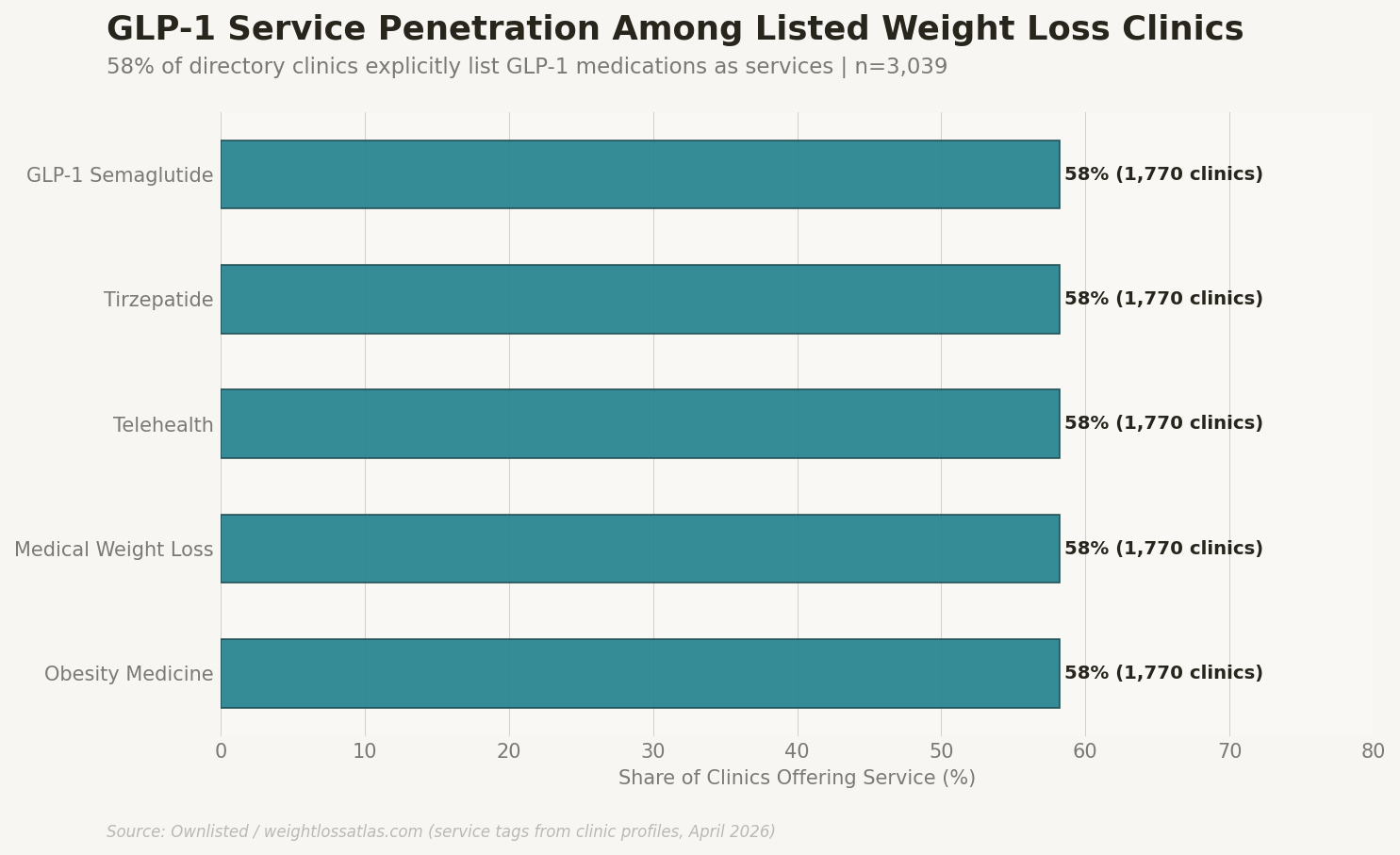
Bar chart showing that 58% of listed medical weight loss clinics explicitly list GLP-1 medications (semaglutide or tirzepatide) as offered services, versus 42% that do not.
GLP-1 Service Penetration Among Clinics58% of listed medical weight loss clinics explicitly offer GLP-1 medications. Source: Ownlisted directory, April 2026.
JSON dataCSV data

Ratings & Reviews: A Near-Universal 5-Star Floor

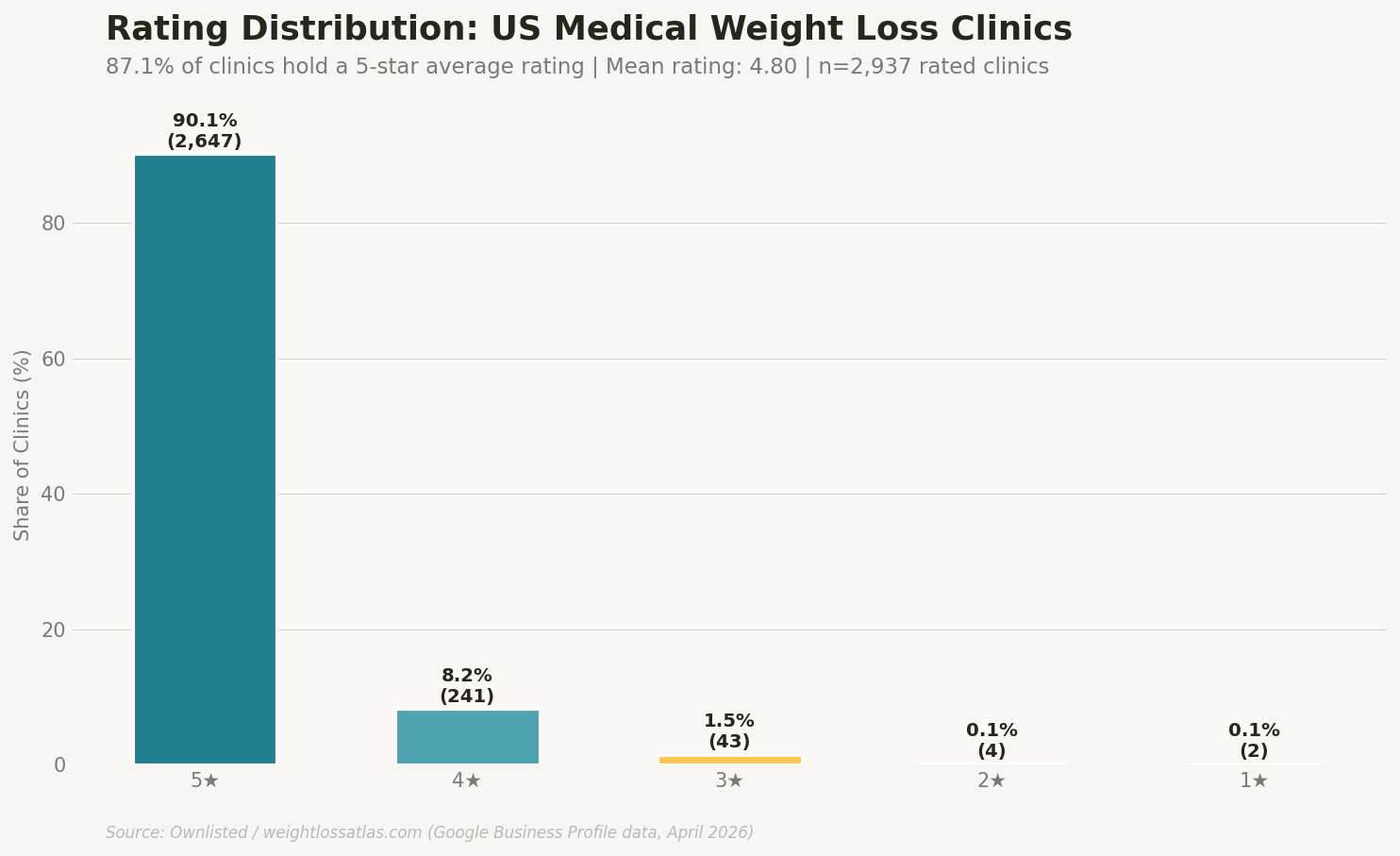
The rating distribution across 2,937 rated clinics is striking: 87.1% hold a rounded 5-star average. The mean rating is 4.80. Only 1.5% of rated clinics fall below a 4-star average.

This compression at the top of the rating scale is characteristic of specialty healthcare. Medical weight loss clinics depend heavily on referrals and reputation; low-rated operators tend to close or rebrand quickly.

Review count distribution: The median clinic holds just 46 Google reviews — modest for a healthcare practice requiring patient trust. The top 4% of clinics exceed 443 reviews, with the most-reviewed clinic accumulating 9,620. This bifurcation — a large cohort of recent entrants alongside a smaller tier of established operators — is consistent with a market that has seen significant new entry since 2022.
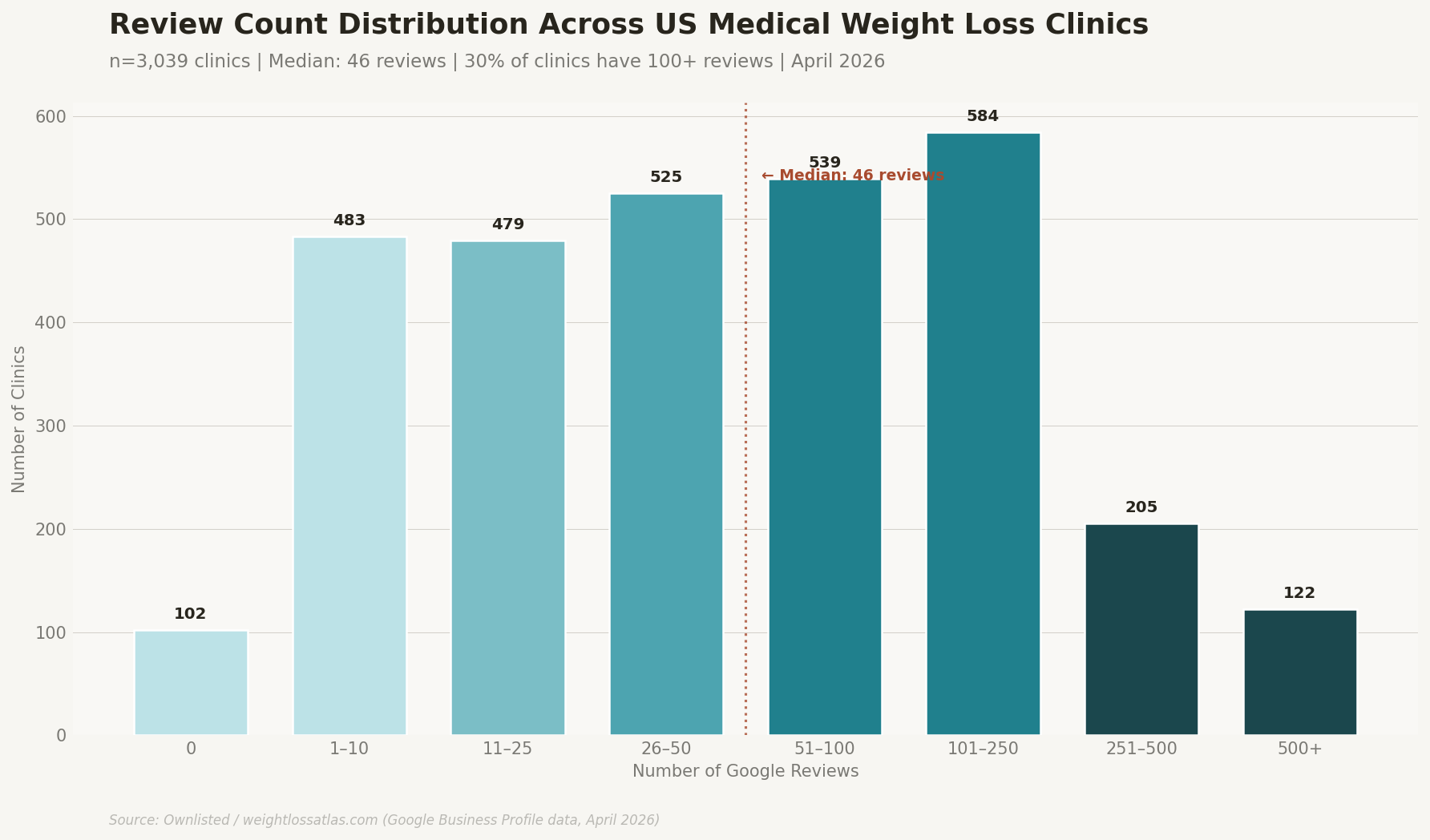
Histogram showing medical weight loss clinic distribution across review count ranges: the largest bars are in the 1-10, 26-50, and 51-100 review ranges, with a long tail of high-review established operators.
Review Count Distribution — Medical Weight Loss ClinicsThe median clinic holds 46 reviews. 102 clinics have zero reviews — consistent with recent market entry. Source: Ownlisted, April 2026.
JSON dataCSV data
Bar chart showing that 87% of rated medical weight loss clinics hold a rounded 5-star Google average, with very few clinics rated below 4 stars.
Star Rating Distribution — Medical Weight Loss Clinics87% of rated clinics hold a 5-star average. Rating inflation is a structural feature of this market. Source: Ownlisted, April 2026.
JSON dataCSV data

Frequently Asked Questions

How many medical weight loss clinics are there in the US?
Our directory maps 3,039 active medical weight loss clinics across 44 US states and Washington D.C. as of April 2026. The actual market is likely larger, as our dataset captures clinics listed under relevant Google Business Profile categories; not all practitioners who prescribe weight-loss medications operate a standalone clinic.
Which states have the most medical weight loss clinics?
California (500), Texas (326), and Florida (235) lead by raw clinic count, reflecting their large populations. On a per-capita basis, Washington D.C. (3.14/100k adults), South Dakota (3.01/100k), and Tennessee (2.30/100k) have the highest clinic density.
Which states have zero medical weight loss clinics?
Eight states appear with zero listed clinics in our directory: West Virginia, Maine, New Hampshire, Delaware, Montana, North Dakota, Vermont, and Wyoming.
What is the access gap in medical weight loss care?
The access gap refers to the mismatch between where obesity prevalence is highest and where medical weight loss clinics are most available. Pennsylvania, Maryland, and Michigan have the worst access gaps — each with more than 79,000 estimated obese adults for every clinic in the directory.
Has the GLP-1 era changed the US medical weight loss clinic market?
The data strongly suggest yes. 58% of clinics in our directory explicitly list GLP-1 medications as offered services. Monthly prescriptions for GLP-1 obesity medications reached approximately 1.5 million by February 2024, up from a much smaller base in 2022. The broader US medical weight loss market more than doubled in value between 2022 and 2024.
What is the average rating of medical weight loss clinics?
The mean Google rating across 2,937 rated clinics in our directory is 4.80 out of 5. Approximately 87% hold a 5-star average (rounded).
Do states with higher obesity rates have more clinics?
Not systematically. Our analysis comparing state adult obesity prevalence to clinic density shows a weak, statistically insignificant negative correlation (r = −0.12, p = 0.46). High-obesity states like Pennsylvania, Michigan, and West Virginia are substantially underserved relative to lower-obesity Western states.

Methodology

Clinic count. Active listings in the Ownlisted / weightlossatlas.com directory as of April 2026, drawn from Google Business Profile data under medical weight loss and related category codes. Listings are filtered for US locations and active status. This is not a comprehensive survey of all licensed medical practitioners who prescribe weight management medications.

Obesity prevalence. Adult obesity prevalence by state from the CDC Behavioral Risk Factor Surveillance System (BRFSS), 2024 data.

Adult population. 2024 state-level adult (18+) population estimates from the US Census Bureau.

Access gap score. Calculated as (state adult obesity prevalence × state adult population) ÷ number of listed clinics. For states with zero clinics, the gap score equals the estimated obese adult population.

GLP-1 market data. Cited from publicly available sources including Grand View Research, IQVIA, J.P. Morgan Global Research, Business Wire / Research and Markets, and News-Medical.

Review and rating data. Sourced from Google Business Profile data as captured by the Ownlisted directory as of April 2026.

Limitations. Our directory may not capture every medical weight loss clinic operating in a given state. States showing zero clinics may have providers who operate under different category classifications in Google's business directory. The access gap metric is a proxy — it measures listed clinic supply relative to estimated obesity burden; it does not measure quality of care, wait times, or insurance acceptance.

Medical disclaimer. This study describes the geographic supply of medical weight loss clinics listed in a business directory. It does not constitute medical advice. All decisions about weight management treatment should be made in consultation with a licensed physician.

Cite this study

Ownlisted Research. (2026). The 2026 US Medical Weight Loss Market: 3,039 Clinics Mapped Across America. Ownlisted. https://ownlisted.com/research/medical-weight-loss-market-2026
https://ownlisted.com/research/medical-weight-loss-market-2026
@misc{ownlisted2026medicalweightlossmarket2026, author = {Ownlisted Research}, title = {The 2026 US Medical Weight Loss Market: 3,039 Clinics Mapped Across America}, year = {2026}, url = {https://ownlisted.com/research/medical-weight-loss-market-2026}, note = {Accessed: 2026-04-24} }

Directory

Find a medical weight loss clinic near you

Browse our directory of listed medical weight loss clinics across thousands of cities. Compare ratings, read reviews, and connect directly.

Explore Medical Weight Loss Clinics

Related research

HVAC Contractors

The 2026 HVAC Contractor Landscape: 4,312 Businesses Analyzed Across 247 US Cities

April 2026

Ownlisted Research

Original data on the home services & professional services industries.

All StudiesPress & DataEditorial PolicyPrivacypress@ownlisted.com

© 2026 Ownlisted. Data is provided for informational purposes. Free to cite with attribution and a link back. See our editorial policy.